
Franklin County Marriage License Chambersburg Pennsylvania
A Franklin County marriage license is processed through the Register of Wills, which handles applications at the Franklin County Courthouse in Chambersburg. Franklin County is in south-central Pennsylvania and shares a border with Maryland to the south. The Register of Wills office manages marriage licenses as part of a broader set of legal records that also includes birth and death certificates and divorce decrees. Both applicants must appear together in person at the courthouse. Contact the Register of Wills directly for current fees, hours, and appointment availability before your visit.
Franklin County Marriage License Office and Elected Officials
The Register of Wills is listed among the elected officials on the Franklin County government website. You can find the office and its contact details at the elected officials page. The courthouse is located in Chambersburg, which is the county seat of Franklin County and the largest community in the county.
Three county commissioners are elected every four years to oversee Franklin County government. The Register of Wills is a separate elected official whose term and responsibilities are set by Pennsylvania law. The office operates independently from the county commissioners in terms of its court record functions.
Franklin County is part of Pennsylvania's 39th Judicial District. This district has its own Court of Common Pleas, and the Register of Wills operates within that court system. Marriage licenses issued in Franklin County are official records of that court.
The image below shows the Franklin County elected officials page, where the Register of Wills office is listed with contact information and department details.
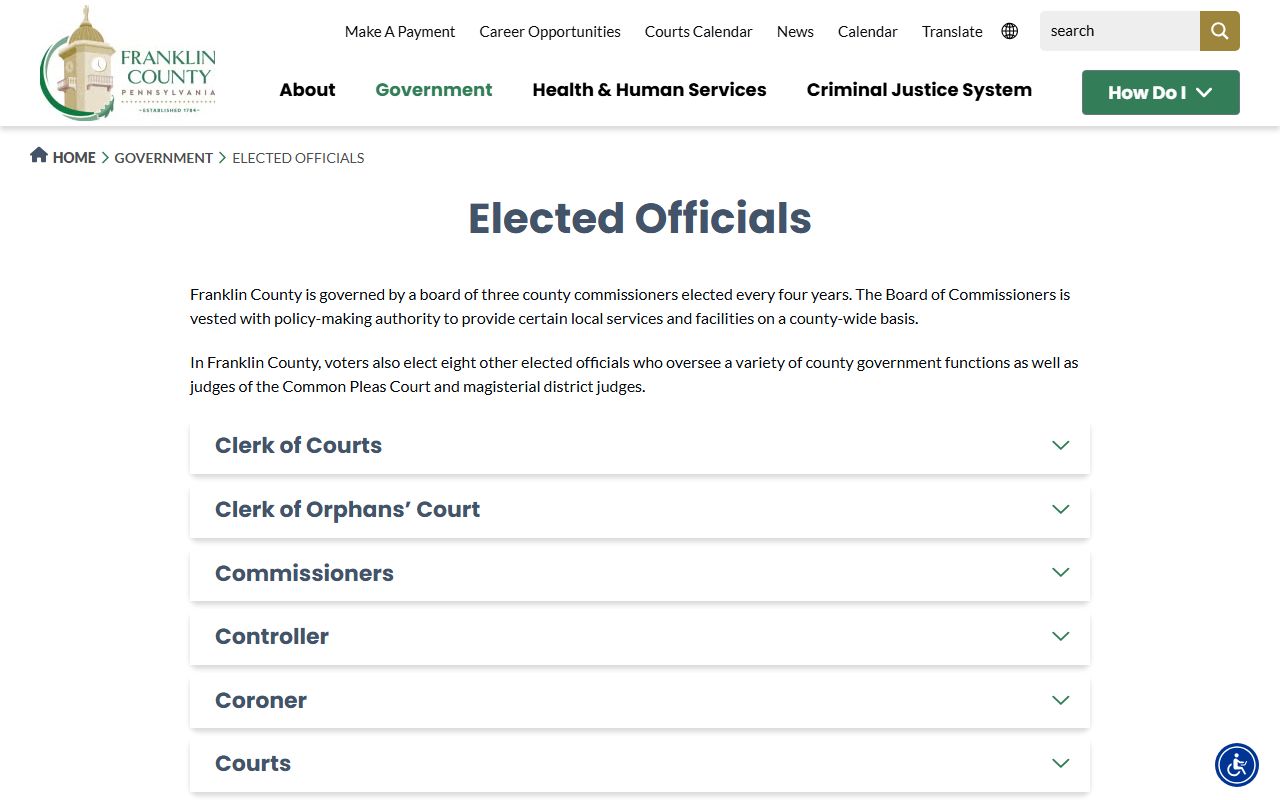
This page is the best starting point for finding the current Register of Wills name and contact information for Franklin County marriage license applications.
Franklin County Marriage License Requirements
Both applicants must appear at the Register of Wills office together. Pennsylvania statute §1306 makes this a firm requirement that applies in all 67 counties. You cannot file on behalf of your partner or ask a family member to stand in.
Each applicant must bring a valid photo ID. A driver's license, state-issued ID, or passport all satisfy this requirement. Both parties must also provide their Social Security numbers. The office uses these to confirm identity and verify that you meet state eligibility rules.
If either person has been married before, bring documentation of how that marriage ended. A certified copy of a divorce decree or a death certificate is required. Bring the original or a certified copy, not a personal photocopy.
Pennsylvania law under §1304(b) sets the minimum age for marriage at 18. Under §1304(e), people related by blood as close as first cousins cannot legally marry in Pennsylvania. Both rules apply in Franklin County.
Note: Contact the Franklin County Register of Wills for current fee information and to find out whether appointments are required before visiting the courthouse in Chambersburg.
Franklin County Marriage License Waiting Period and Validity
After you apply, Pennsylvania law requires a three-day waiting period before the license can be used. This comes from §1303 of Title 23. You may not hold a ceremony on the day you apply or on either of the two days that follow.
Time your application around your ceremony date. If your wedding is on a Saturday, plan to apply by the previous Tuesday at the latest. Also account for holidays when the Register of Wills office may be closed. A holiday that falls during the three-day waiting period does not shorten the wait, but it can affect when you can apply in the first place.
Once the three-day period ends, the license is valid for 60 days under §1310. If you do not hold a ceremony within that time, the license expires and you must apply again. Once you receive the license, note the expiration date and plan accordingly.
Franklin County Register of Wills Responsibilities
The Register of Wills in Franklin County handles more than marriage licenses. The office also manages birth and death certificates, divorce decrees, and estate and probate records. This broad scope makes the office an important part of the county's legal infrastructure.
Because the office manages so many types of records, staff are experienced with questions about how to request documents, what forms are needed, and how long processing takes. When you visit, you can ask staff directly about any additional documents you may need beyond the marriage license itself.
The Pennsylvania Courts statewide directory lists all 67 Orphans' Court clerk offices in the commonwealth. Franklin County's office is included in that directory. This resource is useful if you need to verify contact information or find a comparable office in a neighboring county.
Franklin County Marriage License as a Public Record
A marriage license becomes a public record as soon as it is issued. Pennsylvania statute §1309 establishes this rule. Both parties to the marriage, as well as any member of the public, can request a certified copy of the license from the Register of Wills.
Certified copies are used for a wide range of legal and personal needs. Name changes, insurance updates, and financial account changes often require a certified copy as proof of marriage. Contact the Register of Wills to ask about the current process and fee for obtaining a certified copy after your ceremony.
For historical records or genealogy research, the Pennsylvania State Archives holds vital statistics records going back many decades. Franklin County's history near the Maryland border means that some records may also appear in Maryland state archives for families who lived in the border region. Check both sources if your research spans the state line.
Note: Marriage records are distinct from divorce records. The Register of Wills holds marriage records, while divorce records are typically held by the Prothonotary's office in the Court of Common Pleas.
Who Can Perform a Marriage Ceremony in Franklin County
Pennsylvania statute §1503 lists those authorized to officiate a marriage ceremony in the commonwealth. Judges, justices of the peace, and ordained or licensed religious leaders all qualify. The marriage license does not name a specific officiant. The couple chooses who will perform the ceremony, provided that person meets the legal requirements.
After the ceremony, the officiant must sign the marriage license and return it to the Register of Wills. This signed document is the permanent legal record of the marriage. The record is not complete until the signed license is received back by the issuing office.
Common-law marriage has not been recognized in Pennsylvania since January 1, 2005. Under §1103 of Title 23, any common-law union formed on or after that date has no legal standing. A formal license and a ceremony with a qualified officiant are both required for the marriage to be legally valid in Pennsylvania.
Visiting Chambersburg for a Franklin County Marriage License
Chambersburg is a mid-sized city with accessible parking and services near the courthouse. Interstate 81 passes through the county, making it easy to reach from both north and south. If you are coming from the Maryland border, the drive into Chambersburg is short and direct.
Plan your visit on a regular business day. The Register of Wills office is not typically open on weekends. Check the Franklin County elected officials page or call the office directly to confirm current hours before you travel.
Bring all required documents on your first visit. Missing paperwork will require another trip to the courthouse, which could affect your timeline if you have a ceremony date approaching. Both applicants must attend together, so make sure you coordinate your schedules before booking an appointment.
Franklin County has a strong connection to Civil War history. Chambersburg was burned by Confederate forces in 1864, making it the only northern city to be burned during the war. The county's historical depth is reflected in its courthouse records, which go back many generations and include some of the oldest marriage records in the region.