
Pennsylvania Marriage License Records
Pennsylvania marriage licenses are required before any couple can legally marry in the commonwealth. Each of the 67 counties issues licenses through the Clerk of Orphans' Court or Register of Wills office. You apply in person at your county courthouse, and the license becomes valid after a three-day waiting period. This guide covers where to apply, what documents to bring, what the state laws require, and how to search for historical Pennsylvania marriage records. Whether you plan to marry soon or need to look up a past marriage, the state provides resources at both the county and state level.
Pennsylvania Marriage License Quick Facts
Marriage Licenses in Pennsylvania
No couple may lawfully marry in Pennsylvania without first obtaining a marriage license. This rule has been in place since 1885, when the state required all counties to begin issuing licenses through the Clerk of Orphans' Court. The law is found in Title 23 of the Pennsylvania Consolidated Statutes. Under 23 Pa.C.S. § 1301, a license must be obtained before any marriage ceremony takes place. A license issued by one Pennsylvania county is valid for use anywhere in the commonwealth, so couples are not required to marry in the same county where they applied.
The Orphans' Court Clerk in each of Pennsylvania's 67 counties is responsible for issuing marriage licenses and maintaining local records. These offices handle applications, collect required documentation, administer the oath to applicants, and file the completed license once the ceremony is performed. The Pennsylvania Courts system maintains a full directory of all 67 Orphans' Court Clerks with addresses, phone numbers, and fax information for each county. Every couple applying for a Pennsylvania marriage license must contact the office in the county where at least one of them resides, or in the county where the ceremony will be held if neither applicant lives in Pennsylvania.
The directory of Pennsylvania Orphans' Court Clerks is the best starting point for any couple ready to begin the marriage license process.
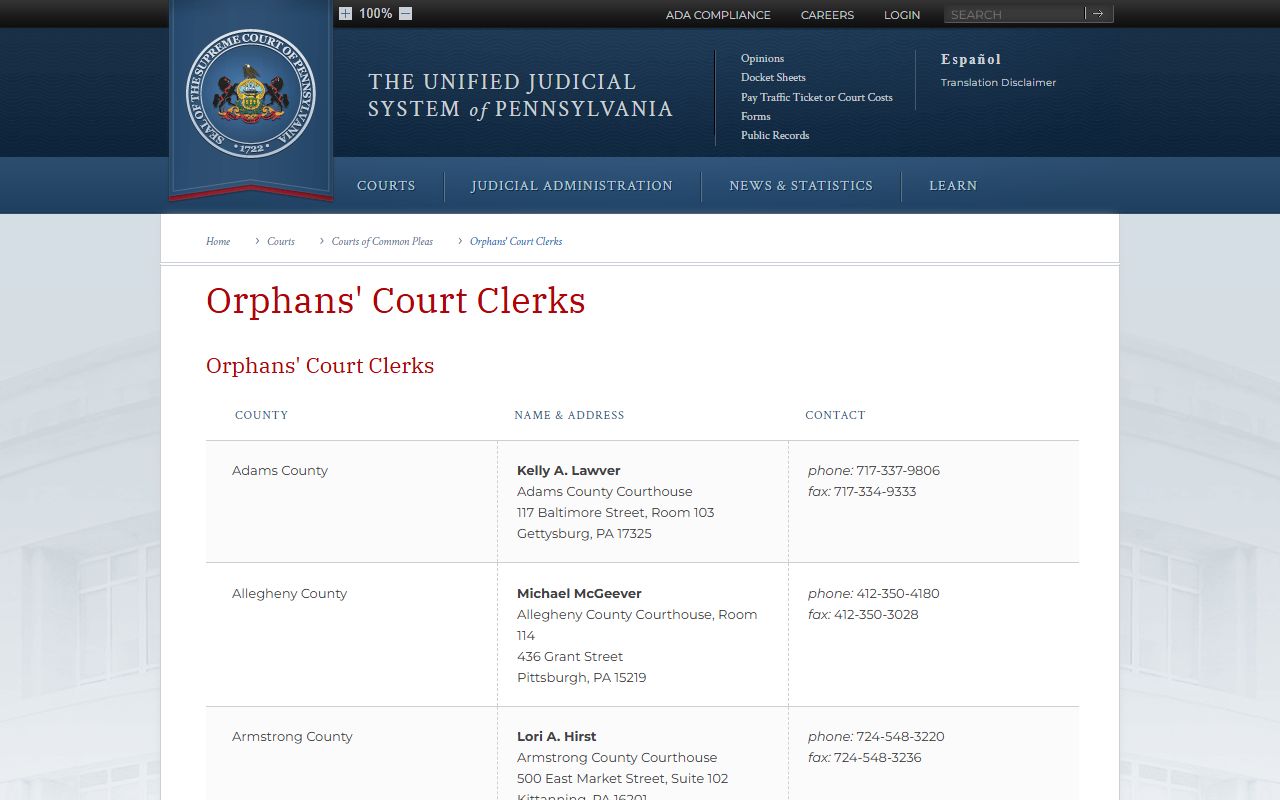
This page from the Pennsylvania Courts website lists every county clerk by name, office address, phone, and fax, giving you the direct contact information needed to apply for a Pennsylvania marriage license.
Who Handles Pennsylvania Marriage Licenses
The Register of Wills and Clerk of Orphans' Court is the office you visit to get a marriage license in Pennsylvania. In some counties these are combined into a single elected office. In others, they operate separately. Both work within the Court of Common Pleas and follow the same state-level rules. The office takes your application, verifies your identity and eligibility, administers the required oath, and issues the license after the waiting period has passed.
Some Pennsylvania counties have modernized the process significantly. Adams County offers a video appointment system through a mobile app, allowing couples to complete much of the process remotely. Montgomery County allows applicants to appear via WEBEX video conference, so both parties can log in from different locations. Allegheny County operates a searchable online database of marriage records dating back to 1885. Erie County launched a new online marriage application system. These options vary widely, so it is always worth checking your specific county before assuming you must appear at a courthouse window in person.
The Pennsylvania Department of Health also plays a supporting role in marriage records. While Pennsylvania counties issue licenses, the state receives copies from every county each month under 23 Pa.C.S. § 1106. The Department of Health maintains records at the state level for research purposes through the Pennsylvania vital records program. Birth and death certificates ordered through this office may be needed if you were previously married and your prior spouse has died.
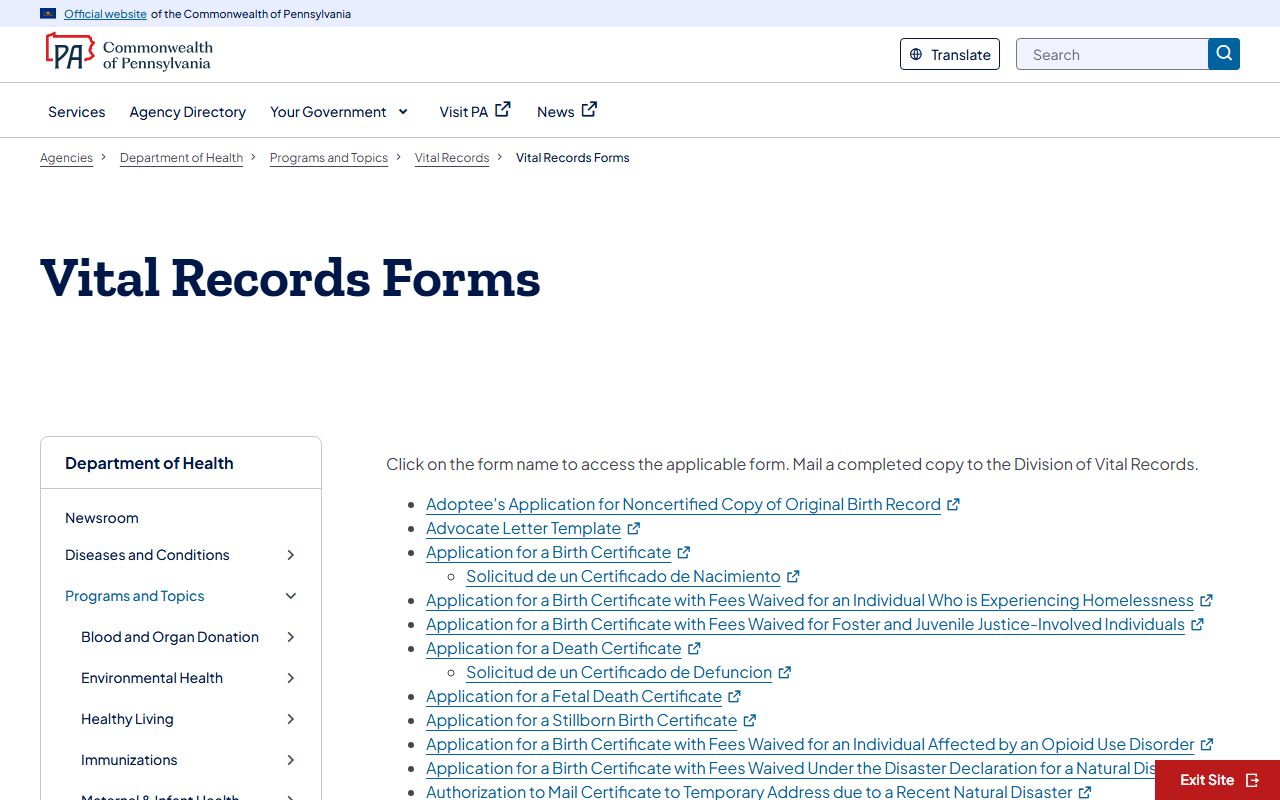
The vital records forms page includes applications for birth and death certificates that divorced or widowed applicants may need when applying for a new Pennsylvania marriage license.
Pennsylvania Marriage License Requirements
Every person applying for a Pennsylvania marriage license must meet the same baseline requirements set by state law. Both applicants must appear together in person before the clerk. You cannot send someone in your place, and you cannot complete the process through a proxy. Each person must be at least 18 years old. Pennsylvania law under § 1304(b) does not permit marriage licenses to be issued to anyone under 18. Blood relatives down to and including first cousins may not marry under Pennsylvania statute § 1304(e).
You will need to bring specific documents with you. These requirements are uniform across all 67 counties because they are set at the state level, though some counties add their own requirements. Carbon County now requires copies of both a birth certificate and a Social Security card in addition to a photo ID. Other counties require just a photo ID and Social Security number. Always check with your specific county office before your appointment to confirm exactly what is needed.
Standard documents required for a Pennsylvania marriage license include:
- Valid government-issued photo ID (driver's license, state ID, or passport)
- Social Security number for each applicant
- If previously divorced: certified copy of final divorce decree
- If previously widowed: certified death certificate of former spouse
- Proof of legal name change if current name differs from prior records
- For non-English speakers: independent interpreter aged 18 or older with photo ID
- Foreign documents must include a certified English translation
The Department of Health vital records page provides context on the documents maintained at the state level that may support a Pennsylvania marriage license application.
Note: Documentation requirements can vary by county, so confirm what your local office needs before scheduling your appointment.
How to Apply for a Marriage License in Pennsylvania
The application process in Pennsylvania begins at your county courthouse. Most counties require or strongly recommend an appointment. You call the Clerk of Orphans' Court, schedule a time, and arrive with both applicants present. Both parties must be examined under oath by the clerk regarding the legality of the marriage and whether any impediments exist. This oral examination is required by 23 Pa.C.S. § 1306. The clerk then files the application immediately as a public record under § 1309 and issues the license.
A three-day waiting period begins the moment you complete your application under § 1303. The clerk may hand you the physical license at the time of the appointment, but you cannot use it until the third day has passed. Marrying within the three-day period makes the marriage legally invalid in Pennsylvania. Emergency waivers exist but require extraordinary circumstances and typically involve a court order. Chester County charges $25 for an emergency waiver. Once valid, the license is good for 60 days from the date of issue under § 1310. If 60 days pass without a ceremony, the license expires and you must begin the application process again from the start.
Birth certificates ordered from the Pennsylvania Department of Health may be required if your county needs additional proof of age or identity during the marriage license application process.
Pennsylvania Marriage License Laws
Pennsylvania's marriage laws are codified in Title 23 of the Pennsylvania Consolidated Statutes, specifically in Part II. The statutes are detailed and cover everything from the application process to who may officiate a ceremony. Understanding the key provisions helps couples prepare and avoid common delays.
Under § 1103, common-law marriage was abolished in Pennsylvania for any union formed after January 1, 2005. Marriages contracted before that date remain valid. Section 1301 makes the license mandatory. Section 1302 spells out what information must be included in the application: full legal names, occupations, birthplaces, residences, ages, whether this is a first or subsequent marriage, parent information, and any facts suggesting a possible legal impediment. Section 1503 sets out who may officiate: judges, magistrates, mayors of cities and boroughs, and ordained ministers, priests, or rabbis of established congregations. Self-uniting or Quaker marriage licenses are also available in Pennsylvania, allowing couples to marry without an officiant if two witnesses are present and sign the license. Self-uniting marriage licenses are available in counties including Elk County, Somerset County, Sullivan County, and Washington County, among others. Couples must inform the clerk before beginning the application if they intend to use a self-uniting license.
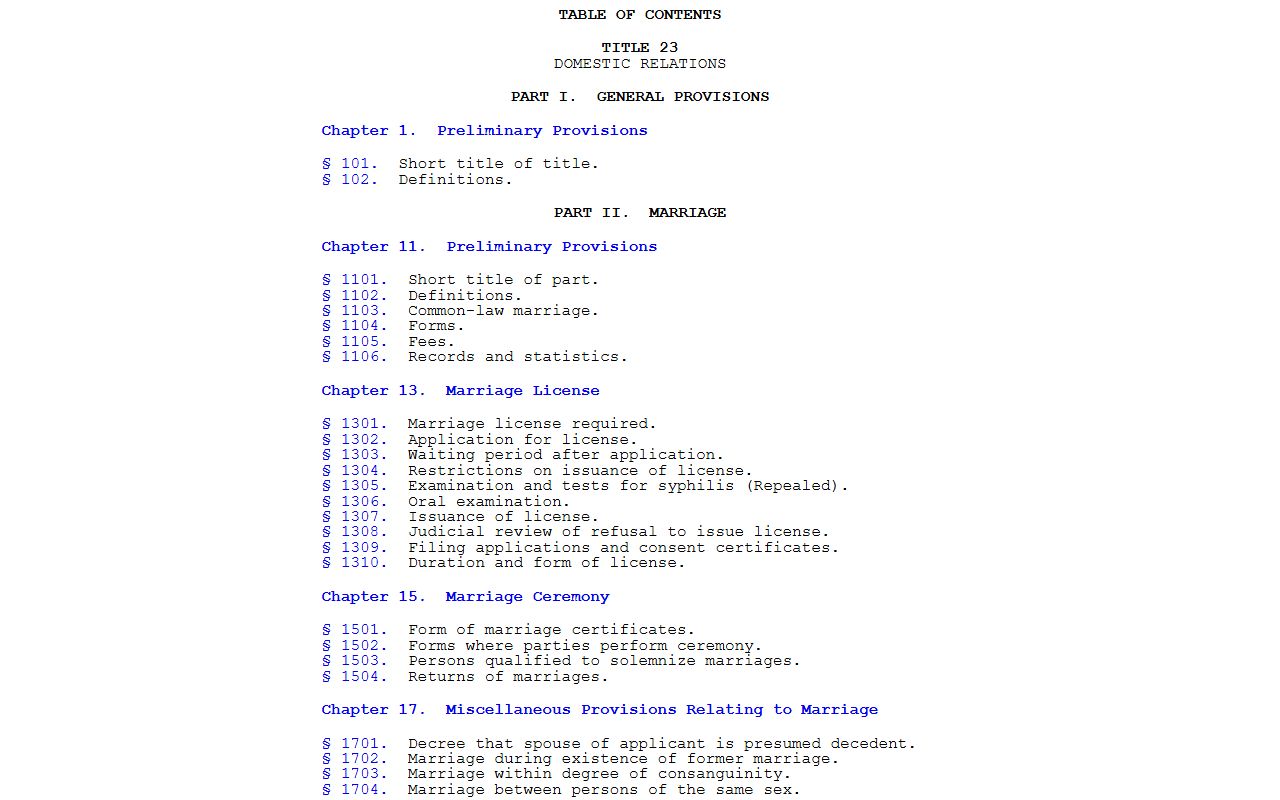
Title 23 of the Pennsylvania Consolidated Statutes is the legal framework governing every marriage license issued across the commonwealth's 67 counties.
Pennsylvania Marriage Records at the State Archives
The Pennsylvania State Archives holds historical marriage records for many counties. Since September 30, 1885, counties have been issuing marriage licenses through the Clerk of Orphans' Court. The State Archives has digitized microfilm copies of marriage records for some counties, available for on-site research in Harrisburg. However, State Archives staff do not search these digitized records on behalf of mail requesters. You must conduct your own search or write directly to the courthouse of the county where the marriage was recorded.
Several collections at the Archives are relevant to marriage researchers. The Governor's Accounts from 1742 to 1763 include lists of marriages for the periods 1742 to 1752 and 1759 to 1762. Marriage Bonds for Philadelphia County from 1784 to 1786 are available with digital images. A Record of Marriages from 1885 to 1891 covers an incomplete listing from various Pennsylvania counties. Records of Births, Deaths, and Marriages from 1852 to 1854 also exist at the state level. For more recent records, the county courthouse of the place where the marriage occurred is the primary source. The State Archives vital statistics page explains what is held at the state level versus what must be sought at the county level.
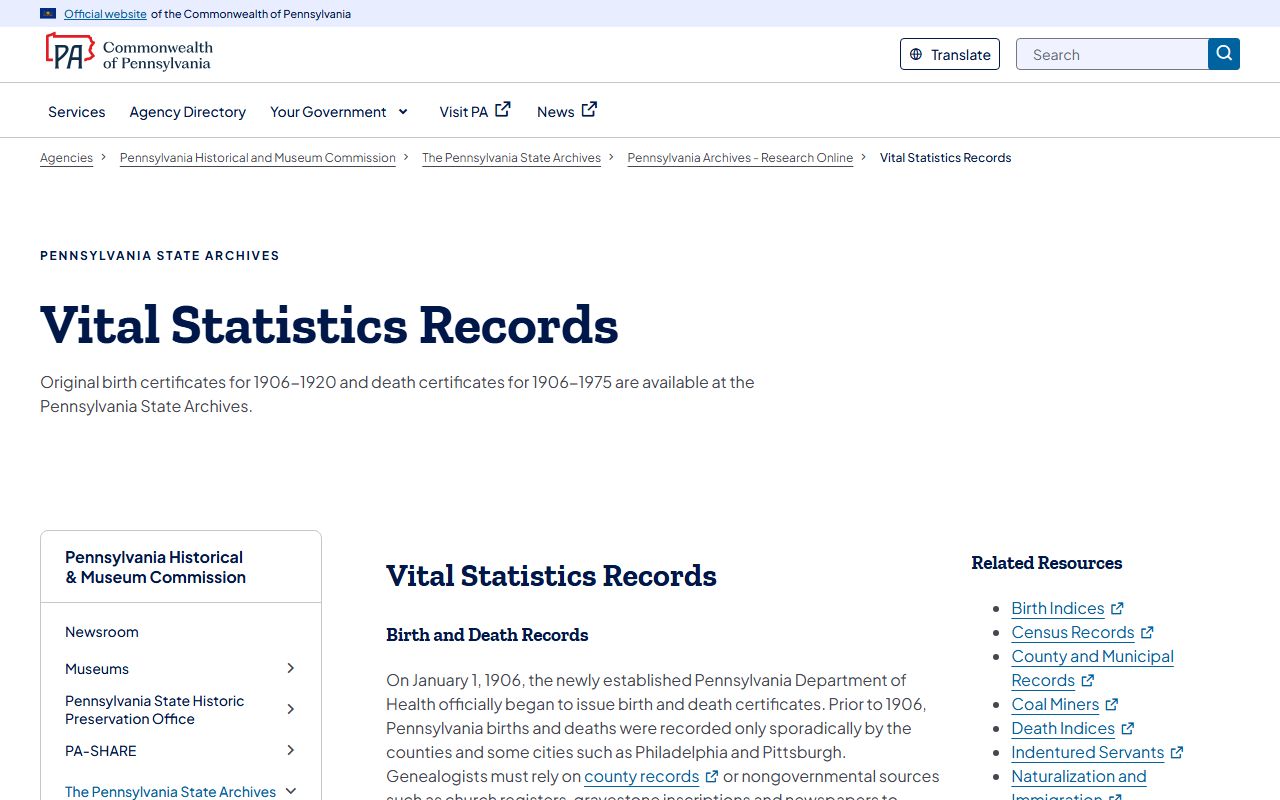
The State Archives vital statistics page is the best starting point for researchers who need historical Pennsylvania marriage records predating the modern county system.
The Pennsylvania genealogy records page provides further guidance. Self-search of records at the Division of Vital Records is not permitted; staff must conduct all searches. For records predating 1906, contact the appropriate Pennsylvania County Courthouse. Indices for public records are available at the Pennsylvania Historical and Museum Commission, covering birth records from 1906 to 1913 and death records from 1906 to 1968. Researchers may also direct mail inquiries to the State Archives at 350 North St., Harrisburg, PA 17120, or email ra-statearchives@pa.gov.
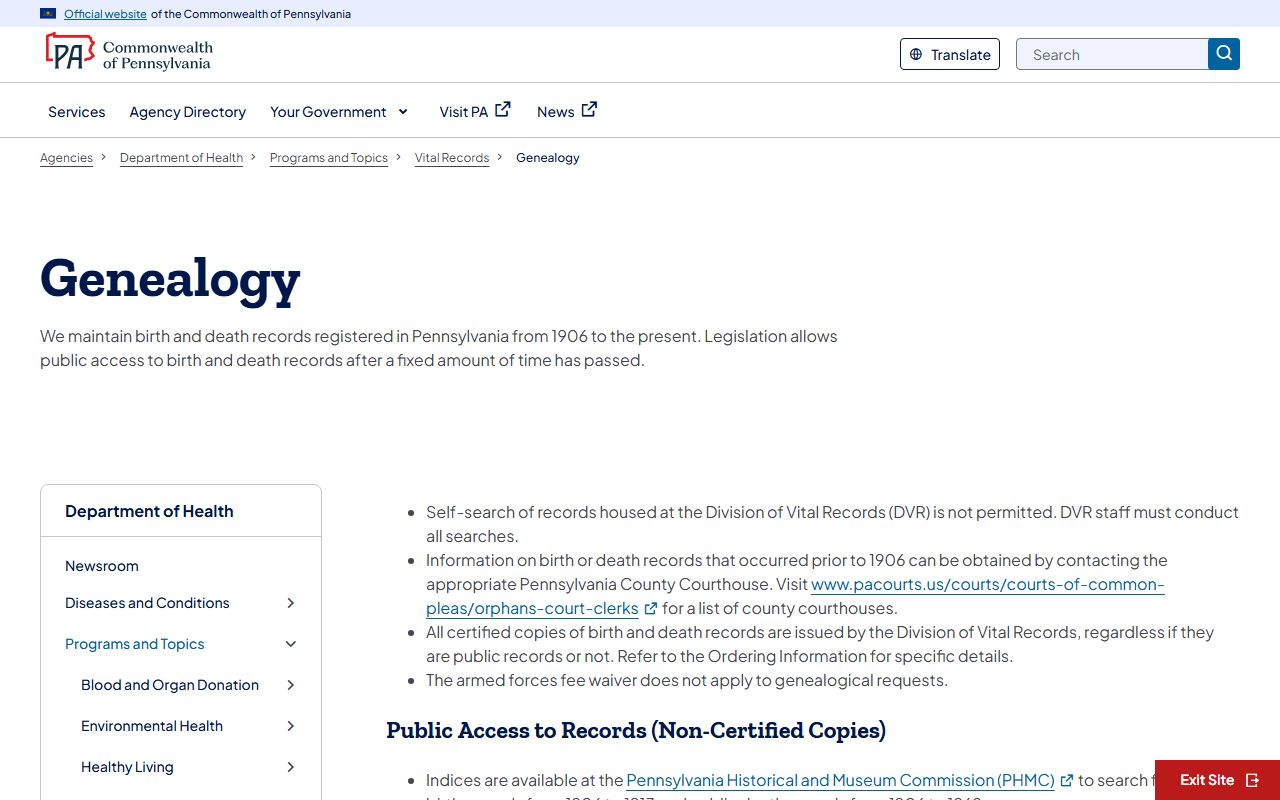
The genealogy page describes the specific procedures for requesting non-certified copies of public records from the Pennsylvania State Archives, including historical marriage research.
Searching Historical Pennsylvania Marriage Records
For researchers tracing marriages from the 19th and early 20th centuries, Pennsylvania counties and the State Archives are both valuable sources. Marriage license dockets from 1885 onward are held by most county courthouses. Some counties have digitized their records. Berks County maintains a searchable online index of over 750,000 marriage applications from 1885 to the present. Allegheny County provides a free online search tool with records dating to 1885. Clearfield County maintains a complete computerized marriage license index. For broader genealogical research across counties, start with the Pennsylvania State Archives online research portal.
The State Archives holds birth certificates from 1906 to 1920 and death certificates from 1906 to 1975. These records are relevant to marriage research because they can help verify the identities of parties in historical marriage records and trace family connections. Digital copies of 1906 to 1917 birth certificates and 1906 to 1972 death certificates are also available on Ancestry.com, and Pennsylvania residents can access these free through the state's Ancestry partnership.
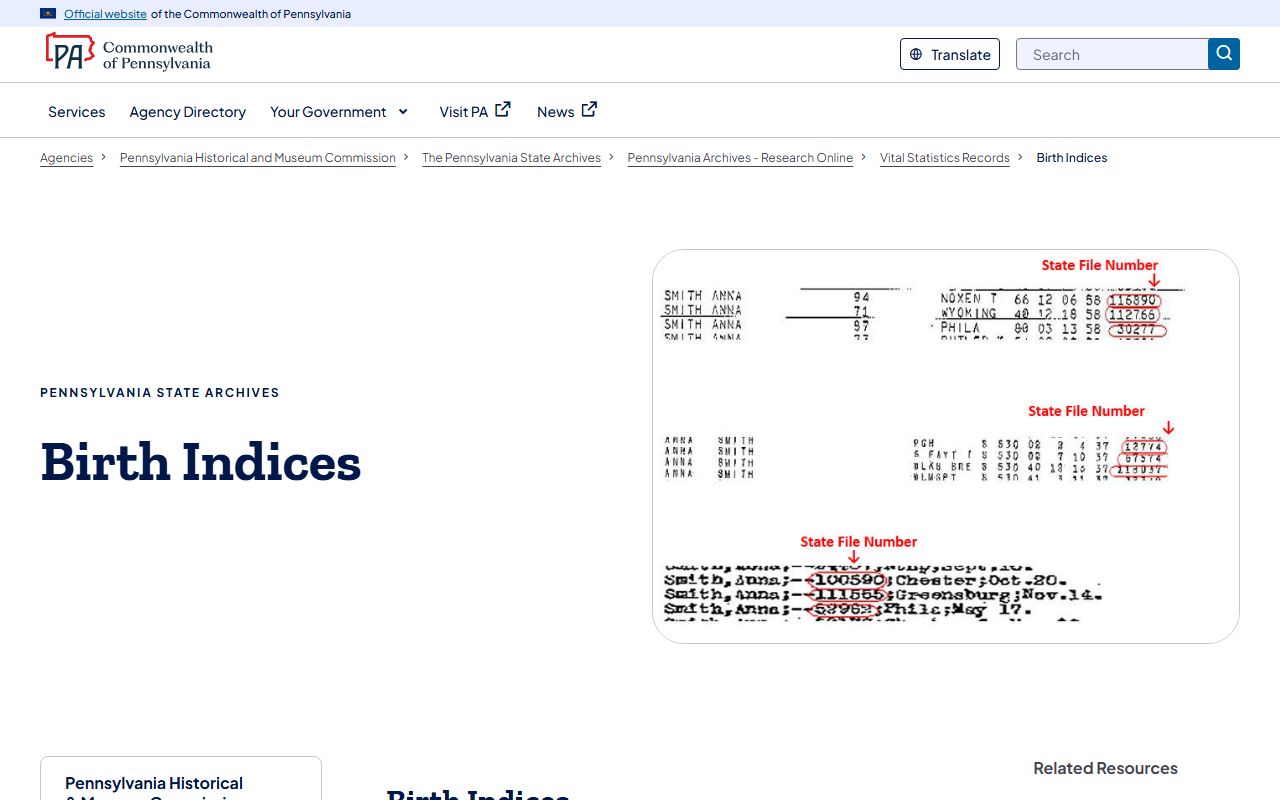
The birth indices database covers 1906 through 1920 and uses a State File Number to locate records, organized by year and first letter of surname.
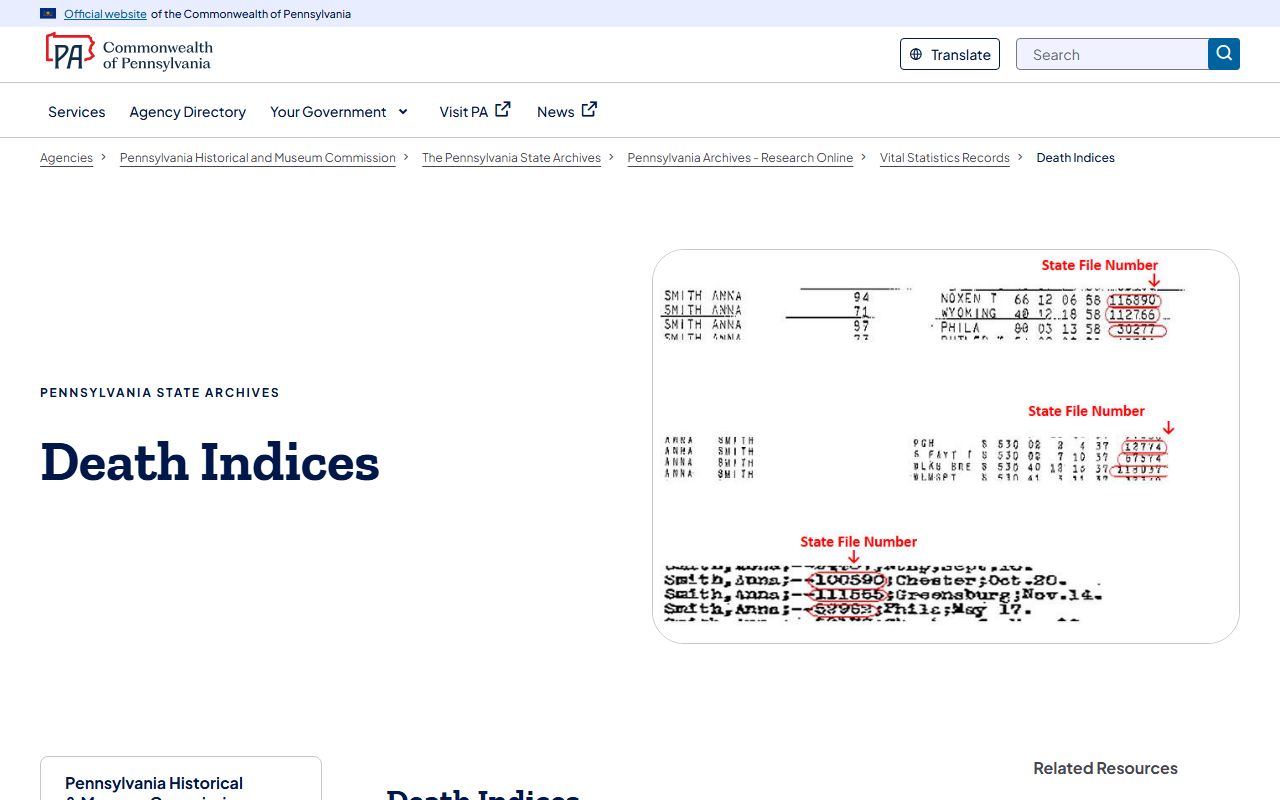
The death indices database covers 1906 through 1975. Records from 1920 to 1924 and 1930 to 1951 use the Russell Soundex indexing method, which groups surnames by sound rather than exact spelling.
Marriage License Fees in Pennsylvania
Fees for a Pennsylvania marriage license are set primarily at the county level. State law under 23 Pa.C.S. § 1105 sets a $3 base fee for issuing a license, with $2.50 retained by the county and $0.50 remitted to the commonwealth. Counties then add their own fees on top of this minimum. In practice, marriage license fees across Pennsylvania's 67 counties range from around $35 in smaller rural counties to $100 or more in larger suburban areas. Lehigh County charges $100, Philadelphia charges $90 for a standard license, Lebanon County charges $80, Westmoreland County charges $70, and Berks County and Chester County charge in the $60 to $75 range. Smaller rural counties such as Sullivan County charge $35.50 and Tioga County charges around $35. Some counties also charge separate fees for certified copies of the marriage license after the ceremony return is filed.
Widowed applicants who need to prove prior marriage dissolution can order a death certificate from the Pennsylvania Department of Health. Certified copies of Pennsylvania death certificates cost $20 each and can be ordered online, by mail, or in person at a Vital Records office. This is separate from the marriage license fee and may be necessary if the original death certificate is unavailable.
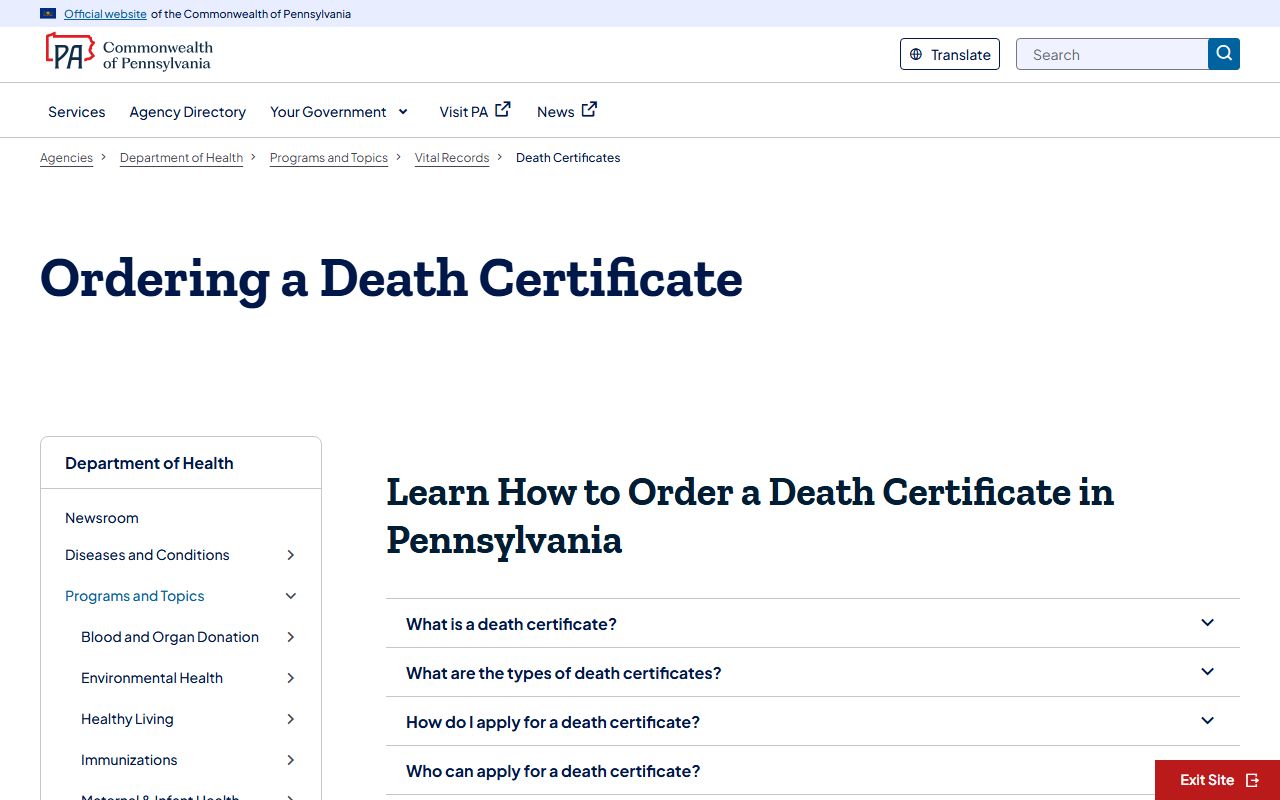
Widowed applicants in Pennsylvania can order certified copies of a deceased spouse's death certificate through the Department of Health to satisfy the marriage license application requirement in any of the 67 counties.
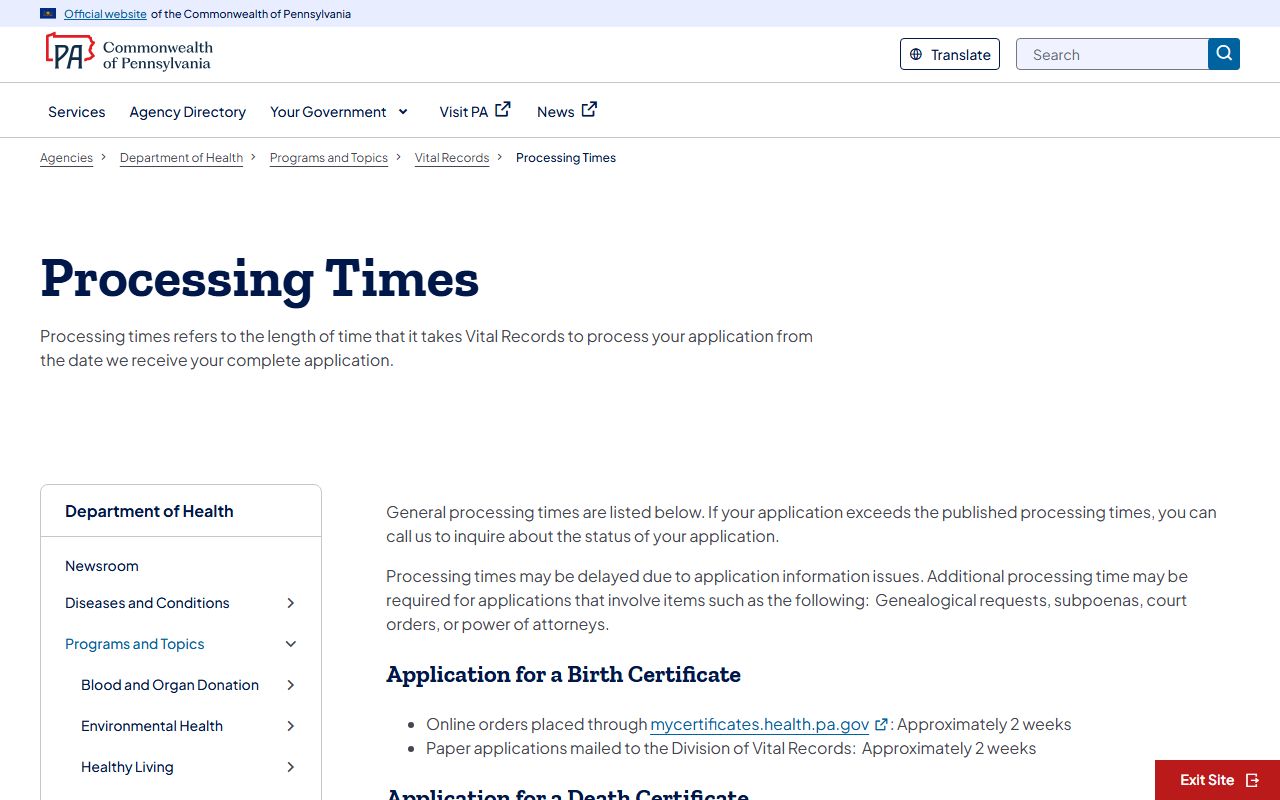
The processing times page shows that standard vital records orders typically take about two to three weeks, so plan ahead if you need a birth or death certificate before your marriage license appointment.
Multi-Year Marriage Record Searches in Pennsylvania
If you are researching a historical Pennsylvania marriage and do not know the exact year, the Division of Vital Records offers a multi-year search option. The base cost is $45 for a 10-year search window, with each additional 10-year period costing $25. You must provide at least the first and last name of the individual and the county of the marriage if known. Any name variant requires a separate application. Multi-year searches take two to four weeks longer than standard requests. Full details are available at the Pennsylvania multi-year search page.
Birth records that are 105 years old or more and death records that are 50 years old or more may be available from the Pennsylvania State Archives as non-certified copies. These older records can be valuable for genealogical research involving historical marriages across the state. The Archives accepts mail inquiries and provides research guidance. Before visiting in person, the Archives recommends starting research online through the Pennsylvania State Archives online research portal, where many records have been digitized and finding aids describe collections not yet online.
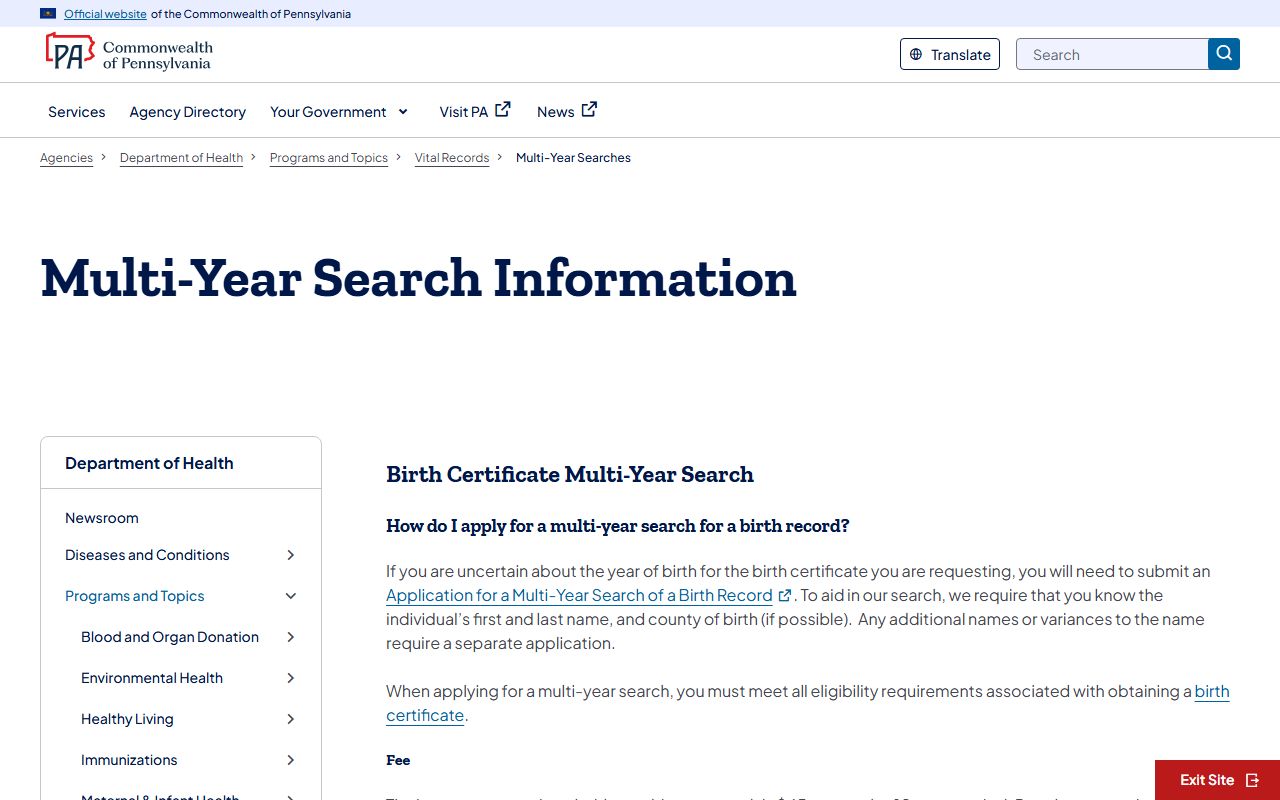
The multi-year search option is useful when you know a Pennsylvania marriage occurred within a general time period but cannot pinpoint the exact year from available records.
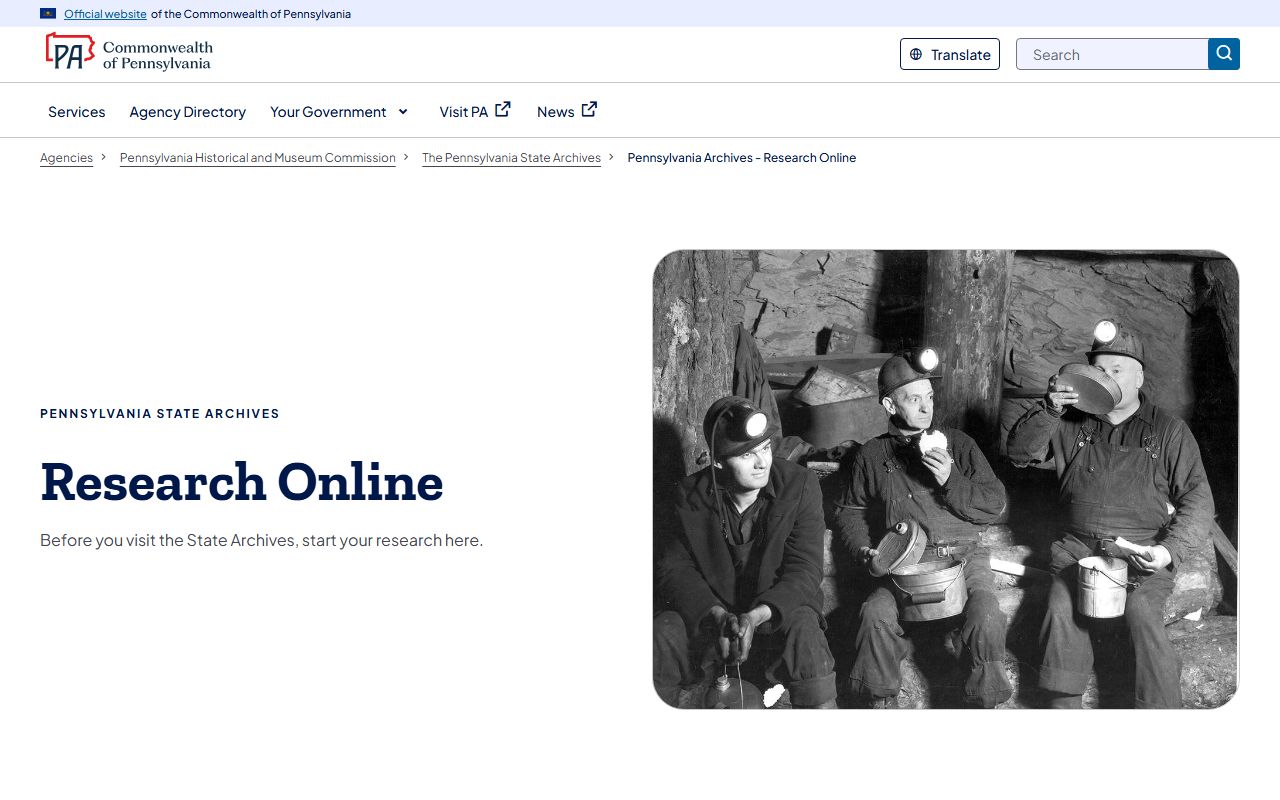
The Pennsylvania State Archives research portal allows users to browse record groups, view digitized documents, and access finding aids for collections that have not yet been digitized.
Browse Pennsylvania Marriage License Records by County
Each Pennsylvania county has its own Clerk of Orphans' Court that issues marriage licenses and keeps local records. Select a county below to find contact information, office hours, fees, and instructions specific to that area.
Pennsylvania Marriage Licenses in Major Cities
Residents of major Pennsylvania cities apply for marriage licenses at the county courthouse serving their area. Select a city below to find the right office and learn about local procedures.